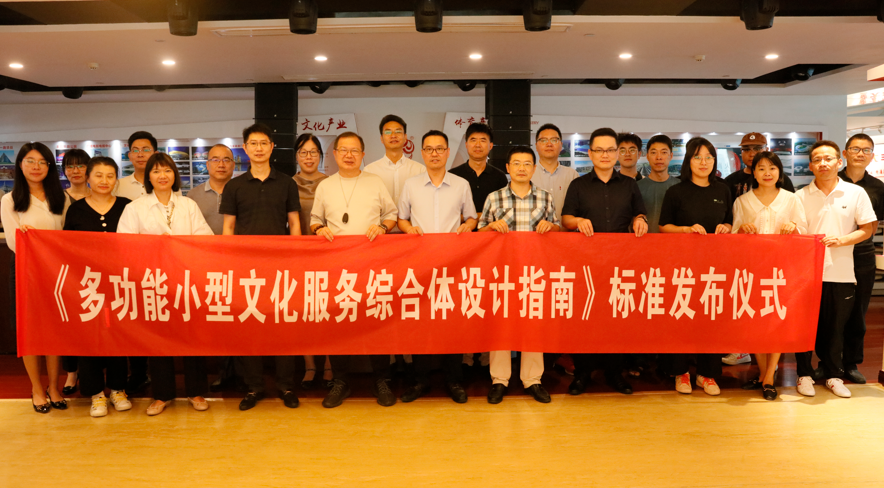
On September 17, the performance evaluation meeting for each sub-project of the key special project under the 13th Five-Year National Key R&D Program, "Research and Application Demonstration of Key Common Technologies in Modern Service Industry," titled "Research and Application Demonstration of Technology for Constructing Multi-functional Small Cultural Service Complexes," led by Zhejiang Dafeng Industrial Co., Ltd., was held in Hangzhou. Feng Qiyun, Deputy General Manager of Zhejiang Dafeng Industrial Co., Ltd., delivered a speech, and Qiao Wei, Deputy Director of the Science, Education and Technology Department of the Ministry of Culture and Tourism, gave an important address. The performance evaluation expert group, composed of experts from the Institute of Automation of the Chinese Academy of Sciences, the Institute of Software of the Chinese Academy of Sciences, Renmin University of China, Xi'an Jiaotong University, China Association of Performing Arts Equipment Technology, Zhejiang University of Technology, China Jiliang University, and other research institutions, as well as nearly 80 participants from 10 project participating units including Zhejiang Dafeng Industrial Co., Ltd., Tsinghua University, Zhejiang University, Zhejiang University of Technology, and Communication University of China, attended the meeting in an "online/offline" format. // The "Research and Application Demonstration of Technology for Constructing Multi-functional Small Cultural Service Complexes" mainly targets the needs of small-scale grassroots cultural facilities, multi-use single spaces, and multifunctional cultural services suitable for non-professional public use. By overcoming major scientific challenges in the design of variable spaces in complexes for various cultural activity behaviors, it establishes a theoretical framework for the design of intensive cultural service complexes in China, breakthroughs in key technologies such as the adaptability and multifunctionality of small cultural service complexes, development of modular support equipment for variable space and enhancing space functions, and innovative construction of complexes with variability, multifunctionality, and adaptability...

On September 17, the performance evaluation meeting for each sub-project of the key national R&D program during the '13th Five-Year Plan,' titled 'Research and Application Demonstration of Common Key Technologies in Modern Service Industries,' and specifically the key project 'Research and Application Demonstration of Technology for Constructing Multifunctional Small Cultural Service Complexes,' led by Zhejiang Dafeng Industrial Co., Ltd., was held in Hangzhou. Feng Qiyun, Deputy General Manager of Zhejiang Dafeng Industrial Co., Ltd., delivered a speech, and Qiao Wei, Deputy Director of the Department of Science, Technology and Education of the Ministry of Culture and Tourism, gave an important address.
![50X3`21U9][S`M54WGJ4T{X.png](/uploads/image/20221011/1665466640736178.png)
"Technical Research and Development and Application Demonstration of a Multifunctional Small-scale Cultural Service Complex"Mainly targeting the needs of grassroots cultural facilities to be smaller in scale, have multi-use single spaces, and provide multifunctional cultural services that can accommodate non-professional users, this aims to address major scientific challenges in the design of adaptable spaces for complexes catering to various cultural activity behaviors. It seeks to establish a theoretical framework for the design of intensive cultural service complexes in China, overcome key technologies such as adaptability and multifunctionality in small cultural service complexes, develop modular support equipment for variable spaces and enhanced space functionality, and innovatively build a cultural complex carrier that is adaptable, multifunctional, and flexible, with effective operational demonstration. It also explores complex operation service models to create new growth points for grassroots cultural services. Once completed, the multifunctional small cultural service complex can meet the service demands of various cultural activities such as performances, meetings, reading, exhibitions, folk activities, and indoor sports activities.
The leaders of each project provided the expert panel with detailed reports covering the project overview, implementation status, completion of indicators, project results statistics, organizational management, and project funding. The expert panel carefully listened to and reviewed the performance reports of each project, giving high praise to the projects' significant importance and innovative findings, while also providing candid guidance for future research directions. The expert panel unanimously agreed that all projects had achieved their expected research goals, with significant social benefits, and approved them through the project performance evaluation and acceptance.